Understanding what the ego is, is essential because it’s the only way to truly understand the mind. And when you see it clearly, many of the illusions you’ve been holding about the mind begin to dissolve. At least, that’s what happened for me.
This article might sound a little confusing in the beginning but everything will become clear as you read the article and then the final conclusion. Let’s begin.
What is Ego?
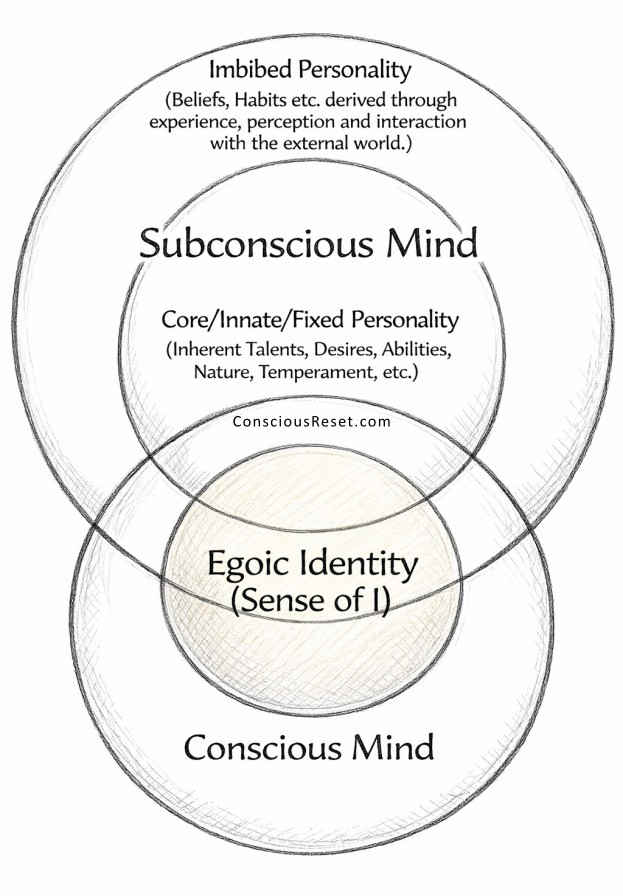
Simply put, your ego is your sense of I created by your Conscious Mind, using the data (all beliefs) present in your Subconscious Mind.
For instance, my name is so and so, I don’t like politicians, I’m a Christian, I’m a sensitive person, I like football, etc. All of these beliefs are connected to the ‘I’ at the very core of your being.
Interestingly, there are two aspects to your ego – a core aspect that is fixed and a fluid aspect that is flexible which builds on top of the fixed aspect. Both these aspects exist in the subconscious (primal) mind. The conscious mind is the one that creates the ego (or sense of I) using these two aspects.
Let’s understand this with more clarity.
Understanding Ego from a Deeper Perspective
In order to understand ego from a deeper perspective we need to start from the very scratch. In other words, right from the conception of a human being. This way, we can figure out exactly when the ego begins to develop and what it constitutes.
So let’s begin.
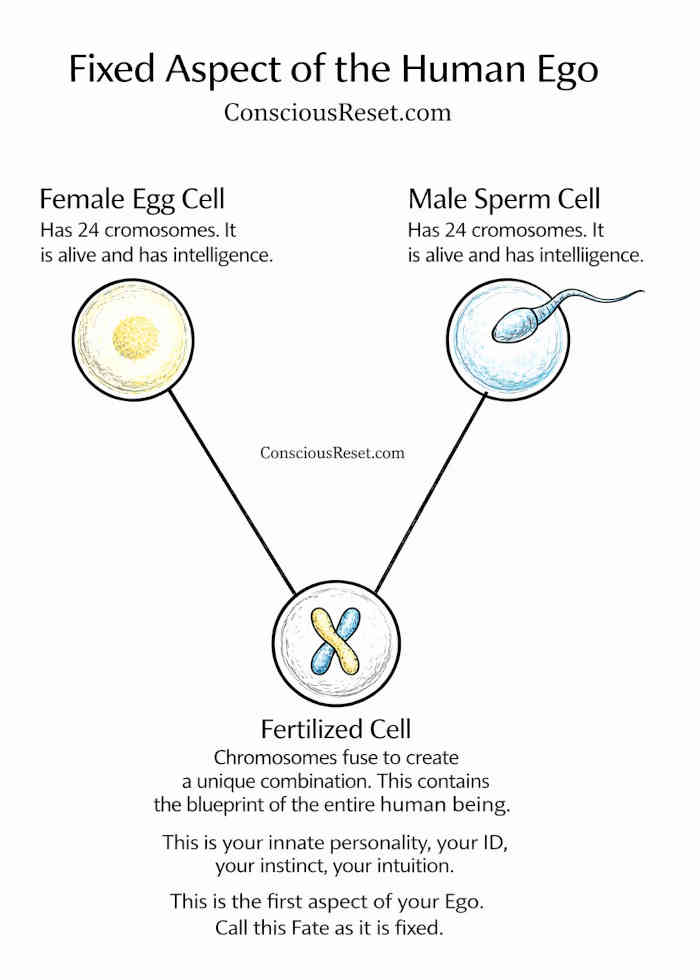
A human life begins when an egg cell from the female body is fertilized by a sperm cell from the male body.
It’s important to note here that the female egg cell and the male sperm cell are already alive (have a soul) and contain intelligence.
The very fact that the sperm cell actively makes its way toward the egg cell proves that it is alive and guided by an inherent intelligence. In other words, both of these cells carry life energy or what many traditions would call the soul.
The female cell contains the following intelligences:
- Consciousness/Soul/Life energy.
- One half of the intelligence to create a human being.
- Personality traits from the mother’s side/lineage/ancestors .
- Emotional memory from the mother’s side/lineage/ancestors.
The male sperm cell likewise carries the same forms of intelligence:
- Consciousness/Soul/Life energy.
- The other half of the intelligence to create a human being.
- Personality traits from the Father’s side/lineage/ancestors .
- Emotional memory from the Father’s side/lineage/ancestors.
According to science, the sperm cell contains 23 chromosomes, and the egg cell also contains 23 chromosomes. When the sperm enters the egg, these chromosomes combine in a largely random manner, to create a unique genetic pattern.
The resulting cell, known as the fertilized cell (or zygote), contains the complete genetic blueprint required to form a new human being.
This blueprint carries a unique combination of traits – some inherited from the father’s lineage, some from the mother’s lineage, and some arising from entirely new genetic combinations.
These form the core (or fixed) personality traits of the human being which includes inherent talents, desires, sexual orientation, interests, temperament, etc. Even physical characteristics such as height, skin color, and many aspects of appearance are largely determined at this stage.
Of course, some of these traits can be influenced or modified by the conditions within the womb and the overall health of the mother.
Here are the intelligences contained in this fertilized cell:
- Consciousness/Soul/Life energy.
- Complete intelligence to create a human being.
- Core/Innate/Fixed personality traits: A unique combination of personality traits from the mother’s and father’s lineage. (this forms the basis of instinct)
- Emotional memory from the father’s and mother’s side (this forms the basis of intuition).
Now the fertilized cell begins to divide from one to two, two to four and so on till after countless divisions a human baby is formed.
First, an embryo develops, containing the basic structures that will become the body’s organs. As development continues, it becomes a fetus, during which the baby grows and these structures mature further.
Among the earliest and most vital systems to develop are the primitive brain and the brain stem (which connects to and continues as the spinal cord), followed closely by the heart.
The Fertilized Cell Contains a Unique Blueprint to Create a Human Being
Development of the human baby – The Heart and the Brain
As mentioned earlier, when a sperm cell enters an egg cell, a fertilized cell is formed which contains the complete blueprint to create a new human being.
The fertilized cell begins to divide first forming the embryo and then the fetus – eventually resulting in a fully formed human baby.
In the embryo state, the focus is on creating the basic organs (heart, liver, etc.), and later in the fetus stage, the focus shifts to growth and maturity.
The first body part to develop is the Neural tube (which becomes the brain and spiral cord), followed by the head and the heart.
Interestingly, the first organ to start functioning is the heart at around Day 22. The next organ to function is the brain and the spinal cord followed by all other internal and external body parts.
Development of the Subconscious & Conscious Brain
As we are trying to understand the ego, it’s important for us to understand the development of the brain.
In a human baby, it’s the subconscious or primal brain that develops first followed by the conscious brain. The development of the conscious brain is gradual. It is said to become fully developed only at the age of 20 to 25.
Note: In animals, the brain is mostly limited to the subconscious or primal brain. The development of the conscious brain is minimal and only happens in higher animals to a limited degree.
Here’s how the brain develops in the human baby:
- The “Survival” Brain (Hindbrain/Brainstem) is the first to mature.
- By the end of the second trimester, the brainstem which controls involuntary functions like heart rate, breathing, and blood pressure is almost entirely developed.
- Next to develop is the limbic system/midbrain, often associated with the subconscious and primal reactions. This includes structures like the hypothalamus (which regulates sleep cycles and emotions) start showing activity around week 28.
- The “Conscious” Brain (Cerebral Cortex) is the last area to fully mature. While it begins forming early in the first trimester, it doesn’t truly take over “duties” until the third trimester and around the time of birth.
- The prefrontal cortex (responsible for complex decision-making and personality) is actually the last part to develop and doesn’t finish maturing until about age 25.
It is clear that the subconscious or primal brain is the first to develop followed slowly by the Conscious brain.
The subconscious, once formed (around week 14 to 20), starts recording information that it receives from the five senses. One can say that the first inputs the brain receives are from touch, followed by taste, smell, sounds and sight.
All these inputs form the initial recordings of the subconscious mind.
This early data isn’t “remembered” like a fact (conscious memory), but rather “stored” as familiarity and safety (subconscious programming). When a newborn is placed skin-to-skin (Touch), hears a familiar voice (Hearing), and smells the mother (Smell), their primal brain identifies these as “safe” based on the subconscious archives created in the womb.
Therefore, when the baby is in the womb, it has the following intelligence:
- Consciousness/Soul/Life energy.
- Cellular memory (from past generations) – which is responsible for intuition.
- Core personality traits like likes, dislikes, desires, talents, nature, temperament, etc. (which is the basis of instinct)
- Initial safety data in the Subconscious mind
Other than this, one can say that the brain of a baby is pretty much empty. Thus you can safely assume that at this point there is no development of an egoic identity.
Development of Egoic Identity
It is clear so far that when the baby is in the womb, the first brain to develop is the primal brain or the subconscious brain. The development of the conscious brain is minimal.
This is why after being born, the baby is not conscious of itself. Upon looking in the mirror the baby won’t be able to identify itself. The conscious brain begins to develop as the baby grows.
For the first 1 year or so, all inputs from its environment go directly to the baby’s subconscious mind without any filter.
It is between the 18th to 24th month that the development of the conscious brain is high enough that the baby starts to recognize itself in the mirror.
Thus, this stage marks the beginning of an Egoic identity or a separate sense of self.
So it’s clear that for an egoic identity to exist, you need the conscious mind. The conscious mind uses information stored in the subconscious mind to create a sense of I. And this is what the Ego is.
So basically, the ego is primarily the combination of the following:
- Core/Innate personality traits – likes/dislikes, talents, sexual orientation, nature, temperament, cognitive aptitude (power of the brain to learn and analyze information) etc.
- Imbibed personality – all beliefs accumulated in the subconscious mind by interaction with the external environment. Mainly through experience, instructions, and perception.
In the beginning the conscious mind is fully identified with the beliefs in the subconscious mind. This is the default state of consciousness.
Making Sense of it All
Now let’s make sense of everything that has been discussed in this article so far so we can clearly understand the Ego for what it is.
The Ego essentially consists of three parts as follows:
- Innate/Core Personality
- Imbibed Personality
- Conscious Mind
1. Innate/Core Personality
As we saw earlier, the male sperm cell and female egg cell fuse to create the fertilized cell. This fertilized cell contains your core or innate personality – your likes/dislikes, talents, desires, sexual orientation, etc. You can say that this fertilized cell contains the fixed part of your ego as these core personality traits cannot be changed. At the very core, this is what you are. You can even call this your true nature. This is also what gives rise to instinct. In Psychology this is called ID. You can also call this Fate as it is fixed and cannot be changed.
The fertilized cell also contains memory (from all past generations) which form the basis of intuition (things that you innately know).
Instinct and intuition are for the most part, deeply connected and its hard to differentiate one from the other.
Interestingly, this is also where the word – Man comes from. The word Man has roots in the Sanskrit word Manus which means the innate personality of a human being. In-fact, when someone says, thinking from the heart, they actually refer to this innate/core part of your personality.
2. Imbibed Personality
On top of innate personality are the data that you collect from the external environment. This data primarily helps you make sense of your Innate Personality and the world in relation to this Innate Personality.
This part of your ego can be called Intellect (or Buddhi in Sanskrit). In psychology this is called Superego or Morality. This can also be called Free Will as this is flexible with enough awareness.
For instance, if you are taller compared to others around you, your mind will register that input and create a belief that you are tall as compared to others. Now this belief will keep altering based on the data you come across as you continue to live in the world.
Similarly, if you are attracted to drawing and others praise your skills, you will develop a belief that you are good at drawing. But if you come across someone with better skills than you, you will adjust your view accordingly.
Thus beliefs and data picked up from the external environment form the fluid part of your ego.
It’s important to note that the Ego tries its best to sustain itself through defense mechanisms and hence without awareness, the fluid part of your Ego becomes rigid and hard to change.
3. Conscious Mind
Now as we saw earlier, the conscious mind is the one that forms the Ego or Sense of I by mediating between the above two aspects of the Ego.
It analyzes data that you pick up from the external environment, compares it with your core personality traits and forms a sense of I. And this becomes your ego.
Thus Ego is essentially three components as follows:
- Core personality traits – ID, Instinct, Fate, Fixed, Reactive
- Beliefs picked up from the external environment – Superego, Morality, Free Will, Flexible with awareness, Responsive with awareness.
- Conscious mind that creates the sense of ‘I’ (or Ego) using 1 and 2.
One can say, that the subconscious mind is the mind of the body- It Feels. And the conscious mind thinks.
Heart Versus Mind Based Thinking
So far, you must have understand that there are two entities present within you. One is your heart – which is your core personality or Instinct and the other one is your mind or intellect which is nothing but your Conscious Mind.
So when people refer to heart versus mind thinking, this is exactly what they are referring to.
Now you must have heard about the dichotomy of the Heart and the Mind. In Eastern philosophy, it is often described as Manam (heart) versus the Buddhi (intellect).
In-fact, as mentioned earlier, the word Man comes from the Sanskrit root Manam, which means a human is essentially the core personality traits.
The Heart does not think, it feels. Feeling is the language of every cell in your body. In that sense, it is very clear about what it wants and does not know the difference between good or bad. It desires based on its makeup.
For instance, you will see a colorful pastry and instantly a desire arises inside you to eat it. This desire is the desire of the heart. It’s a natural instinct to consume it as it looks colorful and smells good.
Now the intellect kicks in and analyzes the pastry based on the accumulated/imbibed beliefs in the subconscious mind. It comes to a logical conclusion that the pastry is full of white sugar, artificial colors and other additives that are not good for the body.
Now the Conscious Mind is in a dilemma – it doesn’t know if to listen to the instinct or the intellect. Finally, after some thinking it makes a logical decision to eat it but in moderation – half the pastry and not full.
This fight between the heart and mind continues throughout a man’s life. Although, this battle mostly happens in auto mode.
This is because in the default state, the conscious mind is fully identified with the subconscious. It is essentially one with the ego construct that it creates.
Becoming Aware of Your Ego
In the default state, the Conscious Mind is fully identified with the Subconscious Mind. In other words, it is fully identified with the Ego structure it creates. In this state, the ego structure controls you as there is no self awareness. For instance, if you are carrying some negative beliefs in your mind, these beliefs will run your life.
The way to prevent this from happening is awareness. When you shine the light of awareness on your beliefs, you now have a chance to see these beliefs for what they are and thereby slowly replace them with ones that are more congruent to your well being.